The SIEM your insurer wants
Every log source from every client, ingested every few minutes and held for the retention window your cyber-insurance carrier asks about. Priced by identity, not by how many gigabytes your clients happen to generate.
What you are buying
A single searchable record of everything that happened across every client you manage, held long enough to answer for it, with every escalation kept as a numbered report you can produce.
Hal was built for many clients and one team from the first line of code, so every client’s signals sit in one place instead of a console per tenant. Where that shows up →
What one searchable record is worth
Because it is one store rather than eighty, a question can cross clients. The same compromised sender turning up in three tenants is a pattern in one search here, and three separate investigations anywhere else. So is a technique that worked on one client being tried on the next.
The retention is set to the window carriers and auditors ask about, on every source and every client, not on the ones you remembered to configure. And it is priced per identity, so holding a year of a noisy client’s firewall logs costs the same as holding a quiet one’s. The pricing argument in full →
What “on record” actually means here
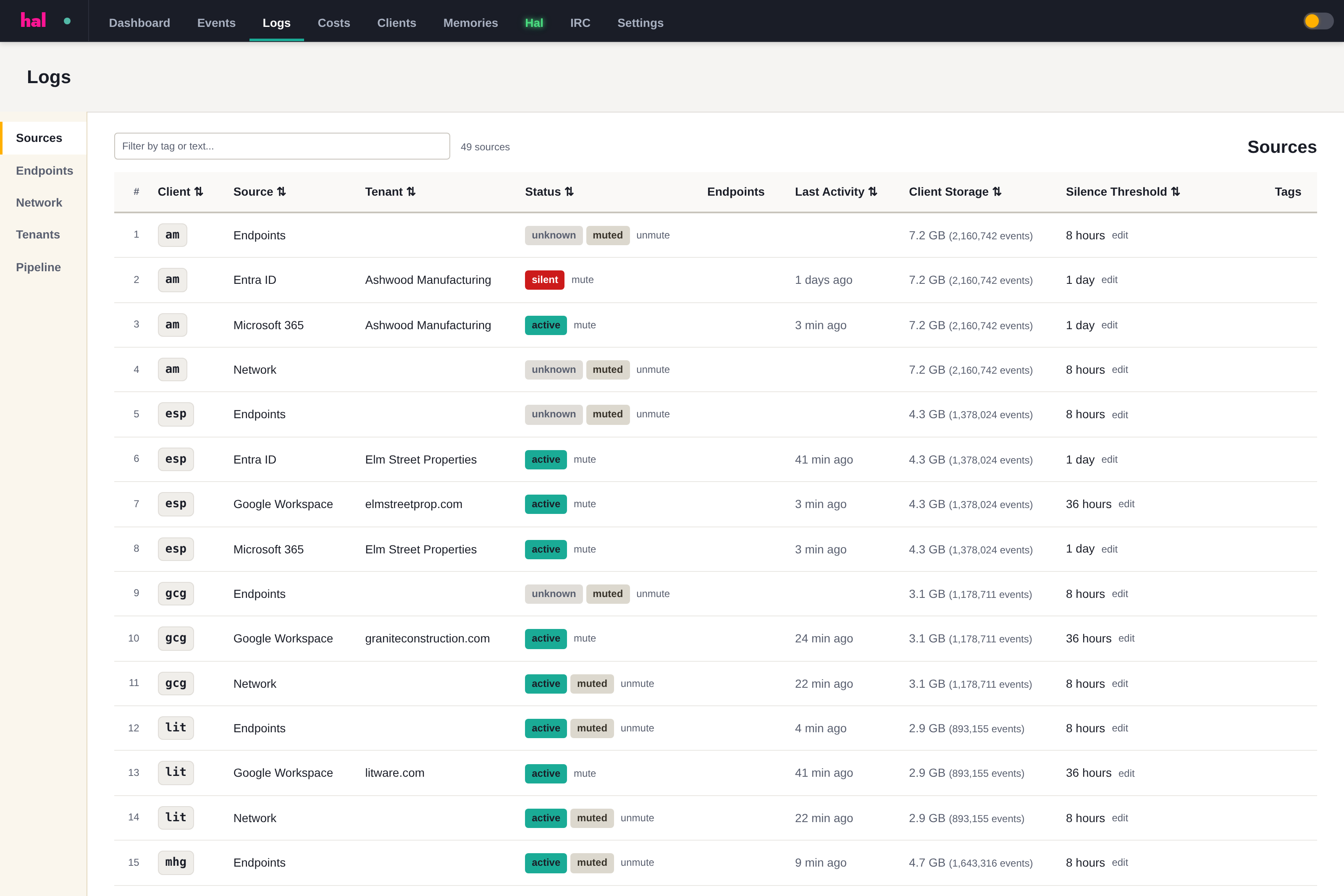
Not “we have logs.” Every source shows its status and last delivery per tenant and per content type; every triage cycle is recorded per client for 90 days; every escalation is a numbered, dated report with the model that judged it and its reasoning, kept for the life of your instance. When someone asks you to prove a nine-month-old event was collected, and what Hal concluded about the alerts that came from it, that question has an answer you can produce rather than reconstruct.
Questions this raises
Will this satisfy my carrier's renewal questionnaire?
What about a client who won't let me install anything?
What happens to the data if we part ways?
See what Hal surfaces on your own clients.
No deck. Ask us anything first. When you want to see Hal on your own tenants, we sign a short evaluation agreement and stand up your instance; you connect one tenant, Hal watches it for 14 days, and we walk you through what he found.
- 01You ask us your questions. No deck, no demo dataset.
- 02You sign a short evaluation agreement, and we stand up your own instance.
- 03You connect one tenant from your own admin console. Hal watches it for 14 days.
- 04We walk through what he found. Keep going month to month, or revoke the scopes yourself and stop.